About me:
Who are you, and what do you do professionally? Since when are you Software Campus participant, and with whom are you collaborating (Industry Partner)?
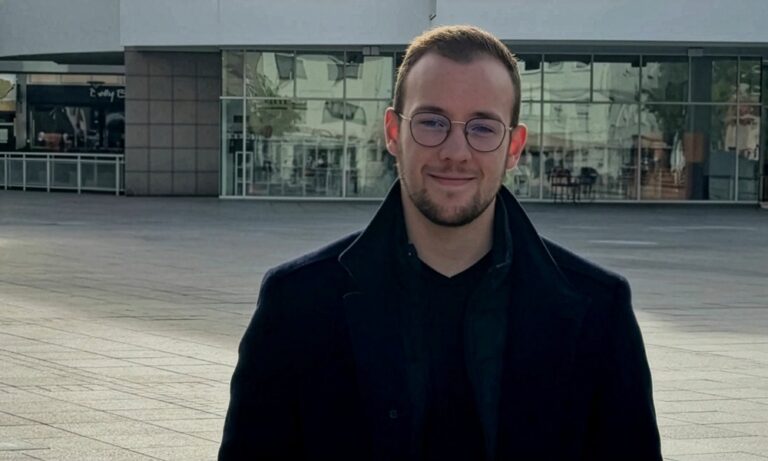
I’m Uwe Gropengießer, a doctoral candidate at the Telecooperation Lab (TK Lab) at Technical University of Darmstadt. My academic focus lies on distributed systems, edge and cloud computing, and software architecture—especially microservices—as well as dynamic adaptation based on the Quality of Results (QoR). Within the scope of the conferral of my doctorate, I do research on methods that guarantee the functionality of distributed services under critical conditions through adjusting the quality of results linked to the system smartly. Since 2022, I’ve been a participant at Software Campus, and I completed my Software Campus research project in June 2025. The collaborating industry partner for my project was Huawei.
What is your IT-Project about – core topic – and how could it be used in the long run?
For my IT project (AQuoR—Adaptive QoR for future edge-surroundings), I dive into challenges of controlling microservice chains in edge-surroundings so that they deliver results reliably within specified time frames even under fluctuating resources (e.g., changing utilization, heterogeneous hardware, variable network conditions). These chains consist of several interdependent services where the overall latency and stability depend heavily on the current context. AI-based components are an obvious—but not compelling—example regarding particularly computationally intense services within such chains.
Within the project, I am therefore analyzing and implementing methods to control the quality of results (QoR) adaptively: During operating time decisions about which chain variant or configuration is used to achieve a goal such as “meeting the deadline” are made—if necessary through a controlled optimization of the Quality of Results (e.g., less complex processing steps or alternative service variants). The approach is based on a model-based description of the range of variants (including dependencies) and efficient selection of runtime so that decisions can be made quickly and robustly even in time-critical situations.
In the long term, this approach can help to ensure that edge systems running on microservice architectures operate with significantly greater reliability and cost-effectiveness: applications can run in compliance with SLAs and deadlines without requiring permanently over-dimensioned hardware, while the platform can respond dynamically to changes in context. It is particularly important for domains such as Industry 4.0, smart cities, connected mobility, or robotics, where distributed services must be provided in a stable, resource-conscious, and scalable manner under real-world conditions.
Career:
What exactly was your personal reason to pursue a career in computer science?
Computers had already fascinated me during my childhood. When I was four or five years old, I had the opportunity to watch my older brother while he was repairing a computer. What I found incredibly fascinating back then was that throughout the multitude of cables and individual components, something functional would ultimately result out of all—which could be immediately visualized on the screen.
Later, I repaired computers myself in a small business next to school. There, I not only gained practical experience but also learned a lot about how these systems actually work beneath the case and why small details in hardware and software can ultimately make a big difference.
Considering today’s major challenges, such as demographic change, climate change, and pressure on resources and efficiency, computer systems are not only useful to me, but increasingly essential. Computer science can make a tangible contribution in many ways toward making processes better, safer, and more sustainable. Simultaneously, I am well aware that digital technologies can also be part of new problems. It is exactly this balance between creative drive and critical thinking of the status quo that led me to computer science and continues to motivate me to this day.
Which was your most challenging experience in your career that you had to face up until now?
My most challenging experiences so far have come at different phases in my career. With regard to the Software Campus, the conferral of my doctorate is certainly the most formative. After five years of working in an industry environment, diving back into scientific work full-time was a significant readjustment. Doing research means working with a lot more uncertainty, questioning results very critically, staying focused, and sticking with a topic for a longer period—even when the path isn’t always clear. This learning curve was challenging, but also very valuable.
Simultaneously, I’ve also experienced intense challenges during my time as team leader at IAV. This included topics such as short-time working during the Corona period, difficult circumstances in project management, and employee queries that require both professional and interpersonal skills. Situations like these teach you to take responsibility, set priorities, and remain action-oriented even under pressure.
In retrospect, I wouldn’t trade any of these experiences for anything. I generally see challenges as part of the learning process. What feels particularly difficult today often becomes part of your routine tomorrow, providing you are willing to learn from it and continue to develop yourself further.
How do you define success?
For me, success means that an idea or a plan leads to something that has an impact and can endure. On a practical level, this means that I have clearly understood a goal, set the right priorities, and achieved it reliably—ideally in a manner that is relatable to others and provides long-term benefits. At the same time, to me, this means staying fair along the way, taking responsibility, and being able to learn from setbacks.
For me, success is not just about achieving personal goals. Success can also lie in seeing and witnessing development, such as watching my child’s first steps. Such moments demonstrate progress and growth without being tied to professional performance. What matters the most to me is that something of value results out of it, either for myself or for others.
Personality
Which values and character traits do you see as fundamental for people in leading positions?
In my opinion, people in leading positions above all need values and character traits that provide guidance and foster trust. If you look around, you will notice repeatedly that loudness, aggressiveness, or pure power dynamics can have a short-term impact, but in the long run, they almost always lead to polarization, a culture of fear, and poor decision-making. Which is why it is so important not to confuse leadership with dominant behavior, but rather with the ability to take responsibility.
That’s why three characteristics are essential to me: integrity, honesty, and clarity. Integrity means that actions and words are in line with each other and that you stand by your commitments, even when it gets uncomfortable. Being honest doesn’t mean being harsh, but communicating with transparency, seeing things realistically, and having the courage to not hide uncertainties or mistakes. Clarity means that a person in a leadership position knows what they stand for, can justify their decisions, and can explain their expectations comprehensibly.
Another key trait is the ability to solve problems and navigate through conflicts. This includes addressing grievances early and directly, rather than sidestepping or sitting them out. Good leadership does not “dither,” but rather identifies problems precisely, creates a framework for solutions, and takes ownership of the consequences. At the same time, empathy and respect are required, since sustainable performance in teams can only be achieved when individuals feel seen and experience psychological safety.
When it comes down to it, a true leader to me is someone who provides guidance, takes responsibility, empowers others, and consistently acts in line with their core values, even when the easier path appears to be the opposite.
Besides your job, what makes your heart beat faster?
My family ♥ ?
Impact
If there was one sentence with which you could reach out to every person, what would you tell the world?
Treat people as if you’d have only that particular moment to make the bond or relationship between you and them a little bit better.
Which app/technical invention is the most essential to you?
This is a question I would probably answer very differently depending on every stage of my life. Currently, since I do have a child, innovations that really make everyday life easier are particularly essential for me, such as devices that automatically shake baby bottles and regulate the temperature. Meanwhile, there are technical inventions that are hardly noticeable in everyday life but protect lives in critical moments, such as airbags and modern vehicle safety systems. If I had to pinpoint one fundamental technical innovation, it would be decentralized, machine-based data processing, or edge computing. They are essential for ensuring that systems continue to function reliably, quickly, and privacy-friendly even when not everything can be migrated to the cloud. It is exactly this ability that is becoming the backbone of modern applications in more and more fields, ranging from mobility to industry.
Source language of this interview: German