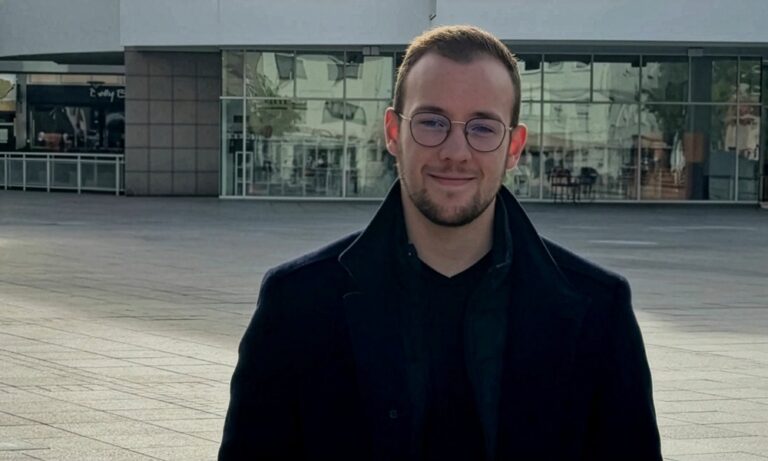
Who are you, and what do you do professionally? Since when are you Software Campus participant, and with whom are you collaborating (Industry Partner)?
I’m Osman Tugay Basaran. I’m working as 6G/AI Research Scientist at the Telecommunications Networks Group (TKN), faculty of Electrical Engineering and Computer Science at TU Berlin. But I’m also a Visiting Research Scientist at the Fraunhofer Heinrich Hertz Institute HHI—Wireless Communications and Networks Department, Signal and Information Processing Research Group of Prof.Dr.-Ing. Slawomir Stanczak—and at the Institut National de la Recherche Scientifique (INRS) Canada, for the Optical Zeitgeist Laboratory of Prof. Martin Maier.
Within the scope of BMFTR-funded 6G-Platform and 6G-RIC projects, I’m focusing on Cognitive Skilled AI Agents, Domain-specific Explainable AI (XAI) and Generative AI (GenAI) algorithms for the implementation and execution of Next-Generation Wireless Networks, Autonomous-Intelligent Radio Access Networks. In Software Campus 2025 Cohort, I will be leading our collaborative project titled “Explainable and Trustworthy AI/ML for 6G” with Huawei. I’m also serving as a Scientific Reviewer in top-tier IEEE Journal/Conferences such as Communications Magazine, GLOBECOM…
What exactly was your personal reason to pursue a career in computer science?
At its heart, my drive to pursue computer science sprang from an innate need to create; not just to build, but to sculpt possibility from the intangible. I was drawn to it as the ultimate ‘digital clay’—a medium where pure logic meets boundless imagination. Observing nature’s profound creativity, the fractal elegance in a fern, the emergent intelligence of a flock, the self-healing resilience of ecosystems, revealed a deeper truth: computation isn’t just circuitry; it’s a language for encoding the genius of the natural world. Computer science became my pathway to not only to understand these patterns, but also to actively participate in that generative process. It empowers me to design AI systems that don’t merely solve problems, but evolve where systems that adapt, restore, and thrive, turning abstract ideas into living, and sustainable solutions. To me, it’s the art of crafting the future’s very fabric, alive with potential.
Which values and/or character traits do you see as fundamental for people in leading positions?
I believe foundational leadership thrives on empathetic stewardship and a growth multiplier mindset where respect isn’t merely given but actively cultivated, creating psychological safety that lets ideas flow freely. Great leaders act as gardeners, not gatekeepers: they nurture shared ownership, listen deeply to diverse perspectives, and recognize that true innovation blooms when every voice feels heard and valued. They champion collaboration over competition, understanding that ‘growing together’ means empowering others to shine and transforming individual sparks into collective fire. By fostering trust, intellectual humility, and a culture where creativity harmonizes rather than clashes, they build ecosystems where sustainable progress and human potential flourish side by side.
What gets your creativity flowing?
What truly ignites my creativity is the potent alchemy of Science and Art History. Let me explain it more visually. Immersing myself in scientific discovery; the elegant principles of quantum mechanics, the ingenious efficiency of biomimicry, the interconnectedness of systems that ecology provides and the rigorous blueprints and functional inspiration for resilient AI architectures is part of my job but also my personal ambition. Simultaneously, witnessing Renaissance masters manipulate light like data pioneers, Bauhaus fuse form with function, or land artists harmonize with ecosystems reveals humanity’s timeless prototypes for beauty, meaning, and context. This described collision sparks my AI design process: science asks, ‘How does it work?’, optimizing for efficiency like cellular metabolism; art history asks, ‘Why does it resonate?’, guiding interfaces with the intuitive grace of a Bruegel scene. Where these streams converge, I find the path to sustainable AI; not just productive computation, but regenerative intelligence designed like a digital ecosystem rooted in long-term value, and human connection transforming cold machinery into a collaborative force for a better future.
Imagine the following scenario: You’d have access to an unlimited budget for sustainable purposes. What exactly would you like to implement?
With access to an unlimited budget for sustainable purposes, I would dedicate it to advancing explainable and trustworthy AI technologies for medicine and healthcare particularly in the field of serious diseases. Since my undergraduate studies, I have been involved in projects on designing AI systems that support both human and environmental well-being. Also, lately, one of our recent research, “XAI-Enhanced Bilateral Molecular Communication: Revealing Cancer Microenvironment Dynamics via Extracellular Tumor Vesicles”, demonstrates how explainable AI can be used to uncover hidden dynamics in cancer progression. With greater resources, I would scale this direction of the research to develop intelligent molecular communication interfaces that enable personalized, preventive healthcare which contributes to a more sustainable and globally accessible medical future.
Source language of this interview: English