
The University of Stuttgart is a leading technical-oriented university in Germany with a global reputation. It sees itself as a hub for university, non-university and industrial research, and as a guarantor of quality and holistic, research-led teaching. The university promotes the transfer of knowledge and technologies to society in all its profile, competence, and potential areas.
With its vision of “Intelligent Systems for a Sustainable Society”, the University of Stuttgart aims to find answers to the major questions of the 21st century and fulfils its social responsibility as a research and educational institution. With its special profile of consistent cooperation between complementary disciplines from all ten faculties, in short, the “Stuttgarter Weg”, it is one of the most successful research universities in Germany and it also enjoys an excellent international reputation. The University of Stuttgart offers around 160-degree programs with more than 20,000 active students.
The University of Stuttgart is home to several clusters of excellence that were selected for funding as part of the Excellence Strategy to strengthen cutting-edge research in Germany. One example of the successful combination of teaching, research, and industry is the research campus “Active Research Environment for the Next Generation of Automobiles” (ARENA2036).
Computer Science, Electrical Engineering, and Information Technology
At the Faculty of Computer Science, Electrical Engineering, and Information Technology, we are dealing with issues that cover the entire spectrum of information and communication technologies, among other things, and cooperate in research and teaching with numerous institutions within and outside the university. One example of this is our participation in Cyber Valley, Europe’s largest research co-operation in the field of Artificial Intelligence and Intelligent Systems. The success of our research activities is underlined, among other things, by our good performance in third-party funding rankings.
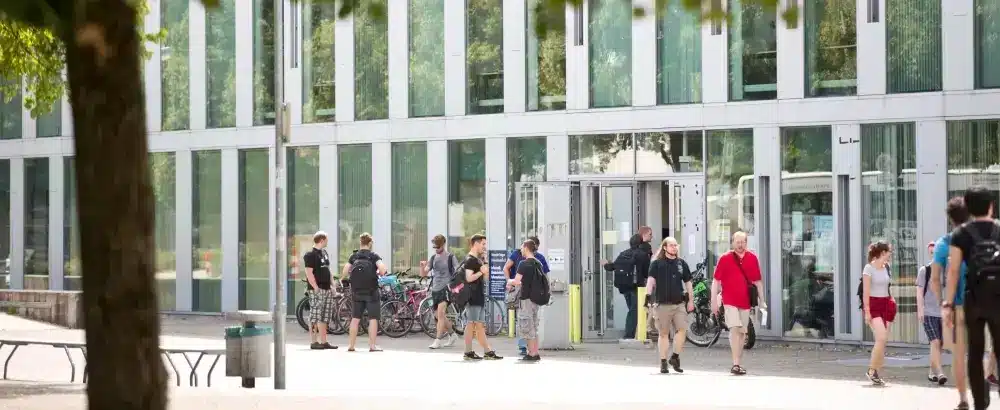
© Regenscheit, Universität Stuttgart
So far, the following projects have been realised in cooperation with University of Stuttgart

PLACEBO: Leveraging NLP for Patient Language Analysis to Capture Expectation-based Treatment Outcomes
PanDa: Adaptive Privacy Protection for Modern Data Architectures

MULTIVIEW: Classifying and ranking perspectives in a set of documents
VALID-PARTITION: Investigations into improving predictive quality by using domain knowledge in partitioning training data
mono2µ: Architecture Refactoring Framework: Descison support and planning basis for system architects

DiSpel – Data-driven specification and verification of resilience scenarios
SWAPS – Software-supported requirements prioritisation in distributed Scrum software development projects


